
Swedish Radiation Protection Foundation – 19apr2024 – auto translation.

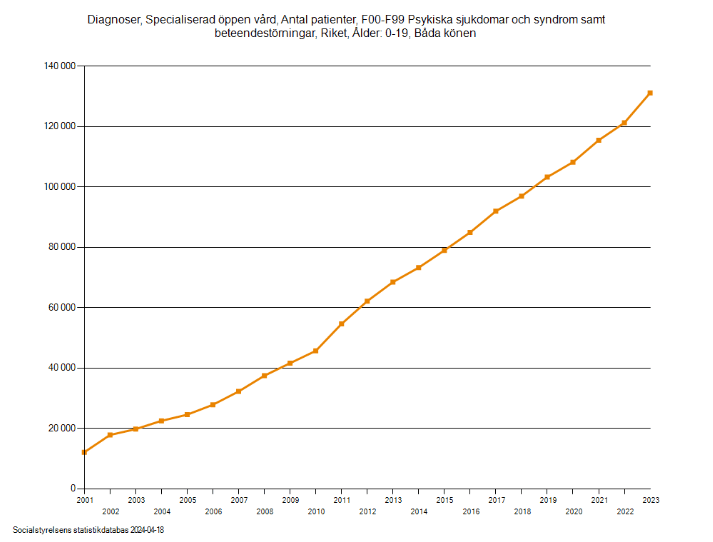
The number of Swedish children with behavioural disorders or mental illness has increased sharply over the past 20 years, according to statistics from the National Board of Health and Welfare. In 2023, more than six times as many children and adolescents aged 0–19 years had one of these diagnoses when visiting specialised outpatient care, compared to 20 years ago. Research has shown that exposure to radiation from wireless technology damages the brain and causes behavioural changes.
The Swedish Radiation Protection Foundation has reviewed the latest statistics from the National Board of Health and Welfare regarding the number of children who have received one of the diagnoses in specialised outpatient care each year that fall into the category of behavioural disorders or mental illnesses or syndromes. Previously, we reported that the number of children aged 0-19 years who have been diagnosed with sleep disorders has increased sharply.
The diagram below is taken from the National Board of Health and Welfare. This is shown by the number of children aged 0-19 years who visited specialised outpatient care every year between 2001 and 2023 and who, according to doctors, have behavioural disorders or mental illness. In 2023, more than 131,000 children with one of these diagnoses visited outpatient care. In 2003, the number was just under 20,000.
The chart below shows the number of children aged 0-19 with behavioural disorders or mental illnesses/syndromes who visited specialised outpatient care each year between 2001 and 2023 per 100,000 inhabitants, age-standardised. Source: National Board of Health and Welfare.

The individual diagnoses that dominate within this diagnostic group (F0-F98) are F90 Hyperactivity Disorder, which increased from just over 2,800 in 2003 to just over 70,000 children aged 0-19 years in 2023.

Another diagnosis within the diagnosis group that has increased a lot is F84 Pervasive Mental Retardation. The chart below shows that the number of children in specialised outpatient care each year with this diagnosis has increased from just under 1,700 in 2023 to just over 21,000 in 2023.

Other diagnoses that have increased are F40-F48 Neurotic, stress-related and somatoform syndromes, from just over 2,500 children in 2003 to just over 20,000 in 2023. Within this group, the diagnosis F41 “Other anxiety disorders” dominates, increasing from just over 900 children in 2003 to just over 14,000 in 2023.
Radiation from wireless technology harmful to the brain
Repeatedly, research has shown extensively that radiation from wireless technology damages the brain and mental health. During the same period as an increased number of children in Sweden suffer from mental illnesses or behavioural disorders, children’s exposure to radiation from wireless technology has increased massively, according to the National Board of Health and Welfare’s statistics. This is due to both foetal and postnatal exposure as a result of increasing use of mobile phones, wireless data networks, wirelessly connected computers and an increasing number of 4G and 5G base stations that emit increasingly strong radiation.
For more than 50 years, researchers have described that it is primarily the brain and the central nervous system that are affected by this form of radiation. Already in 2014, an international expert report (Bioinitiative report) reported that a total of 234 studies published between 2007 and 2014 showed that radiation from wireless technology and low-frequency fields negatively affects the central nervous system. Repeated examinations show that nerve cells die, memory deteriorates and behavior is affected.
Children and young people and unborn foetuses are at particular risk, as stated in the French government report ANSES 2016. Children absorb more radiation and their nervous system is developing. The nervous system develops throughout adolescence. Research has shown that when fetuses are exposed in the mother’s womb, the brain can suffer permanent damage and behavioural disturbances.
Causes behavioural disorders, hyperactivity
In 2012, American researchers showed that exposure during the fetal period leads to permanent brain damage, impaired memory and hyperactive ADHD-like behavior. It is precisely the hyperactivity diagnosis F90 that has increased the most among children over the past 20 years, according to the National Board of Health and Welfare’s statistics above.
Furthermore, in 2018, researchers in animal experiments showed that WiFi-like radiation causes behavioral changes and increased occurrence of markers for cell death in the brain (caspase 3). The researchers concluded that the study clearly shows that radiation leads to harmful effects on the brain, leading to impaired learning and memory and altered anxiety-like behavior. In 2015, researchers showed that long-term exposure to Wi-Fi at low levels altered molecules in the brain that have been linked to Alzheimer’s, cancer and diabetes, etc. The researchers concluded that long-term exposure to 2.4 GHz can cause adverse health effects such as neurodegenerative diseases.
In 2008, a major Danish study was presented on the relationship between mothers’ use of mobile phones and children’s behaviour. The study included more than 13,000 Danish children. At the age of 7, children exposed both during the fetal period and after birth had a higher prevalence of behavioural disorders, in the form of hyperactivity and emotional disturbance.
In 2018, three studies of the association between mothers’ mobile phone use and children’s cognitive ability showed that children of mothers with the highest mobile phone use had poorer cognitive ability at the age of 5.
Impaired memory and learning
Below is an example of a list of research from one of our fact sheets that has shown harmful effects on memory and learning, mainly in animal experiments, up to the year 2018 . This has been known for several years, but the responsible authorities and the government have turned a blind eye to the accumulated evidence:
- Young people aged 15-19 who use their mobile phones have impaired memory function. Study among 670 young people using mobile phones in Switzerland. 2018
- Animal experiments show that mobile phone radiation (GSM 900) impairs memory. Rats were exposed for 4 weeks. 2018
- Animal experiments show that mobile phone radiation causes harmful changes in the gene expression of brain cells, which may explain, among other things, the deterioration of memory in previous animal experiments. 2018
- Rats exposed to WiFi radiation 2.45 GHz have behavioral changes and increased occurrence of marker of cell death in the brain (caspase 3) as well as oxidative stress. The frequency 2.45 GHz gave greater power than 1.8 GHz and 900 MHz. The rats were exposed for four hours a day for 45 days. The researchers conclude that the study clearly shows that radiation leads to harmful effects on the brain, leading to impaired learning and memory and an altered, anxiety-like behavior. 2018.
- Animal experiments show that magnetic fields of 7.5 kHz affect learning and memory, probably via an inflammatory reaction in the hippocampus. 2017
- Exposure to microwave radiation at 10 GHz damages the brain in animal experiments, including impaired memory and learning ability, oxidative stress. 2017
- The use of mobile phones has a significant negative impact on working memory among exposed people in the provocation study. Effects observed already after 5 minutes. The greatest impact is on people aged over 60 and on people with cognitive problems. 2017
- Mobile phone radiation GSM 900 and 1800 damage cells in the brain’s hippocampus (memory, etc.) in animal experiments. 2016
- Elevated levels of low-frequency magnetic fields cause memory impairment. 2016
- The greater the use of the mobile phone or exposure to mobile phone radiation, the poorer the memory among young people. Survey from Switzerland. 2015
- Exposure to mobile phone radiation at low levels, one hour a day for a longer period of time (eight weeks in this study of mice) affects genes. May cause impaired learning and memory impairment by affecting proteins and metabolic processing linked to brain function and diseases. 2015
- Chronic exposure to 1800 MHz mobile phone radiation leads to reduced levels of neurotransmitters (serotonin, dopamine, etc.) which are important for memory, learning and mental health. 2015
- Mobile phone radiation affects the production of serotonin, which is important for memory, learning and mental health, among other things. 2015
- Mice exposed to cell phone radiation, three hours a day for 28 days, have impaired memory and the protective blood-brain barrier becomes permeable. Confirms previous studies that have also shown an impact on the blood-brain barrier and memory. 2015
- Rats exposed to radiation from mobile phones experience harmful changes in brain cells, oxidative stress, and impaired memory and learning. 2014
- Mice exposed to microwave radiation have impaired memory. GABA, a neurotransmitter in the brain that is important for memory, among other things, is affected. 2014
- Low-frequency electromagnetic fields affect functions in the brain that affect memory and learning, among other things.2014
- Mice exposed to mobile phone radiation during the foetal period have impaired memory and learning ability. 2014
- Exposure to GSM 1800 cell phone radiation for up to 120 minutes daily for 30 days at levels below the applicable limit value led to impaired memory and learning ability in mice. Selenium supplementation had a protective effect. 2014
- Exposure to low-frequency electromagnetic fields causes changes in the brain that may explain impaired learning and memory. 2014
- Aluminium and low-frequency electromagnetic fields have the same negative impact on the brain through impaired memory and impaired defence against oxidative stress in animal experiments. 2013
- Mobile phone radiation far below the current limit values alters neurotransmitters in the brains of mice. May explain reported effects on memory, learning and brain stress. 2013.
- Mobile phone radiation causes DNA damage in the brains of mice. In the long run, this can lead to neurodegenerative diseases and cancer. 23 July 2013
- Significantly increased prevalence of sleeping difficulties, headache, dizziness, discomfort, depression, memory disorders, increased irritability and nervousness among residents within 300 meters of cell towers compared to residents at longer distances. 201324
- Mobile phone radiation (GSM 1800) impairs the memory of mice when exposed to mobile phone radiation for 90 minutes a day for up to 148 days at levels well below the applicable limit value (0.11 W/kg). 2013
- Exposure to Wi-Fi-like signals (2450 MHz) causes impaired glucose uptake in the brain which can lead to poorer memory and learning ability. 2012
- Rats exposed to mobile phone radiation for a short period of time (two hours) have an impact on orientation and behaviour as well as changes that indicate oxidative stress. 2012
- Mobile phone radiation below the current limit value causes impaired memory and damage to the brains of mice exposed for a maximum of one month. 28 September 2012
- Mouse foetuses exposed to very low-frequency electromagnetic fields with a complex composition suffer permanent brain damage that manifests itself in behavioural changes. 2012
- Mice exposed to electromagnetic radiation for a total of 200 hours at levels well below the applicable limit value (3 μT) develop symptoms suggestive of depression/anxiety. In addition, levels of corticosterone, which is linked to stress and impaired memory, increased. 2012
- Ants have impaired orientation and memory after exposure to GSM radiation. 2012
- Low-frequency EMFs impair memory in mice. 2012
- Exposure to mobile phone radiation below the limit value during the foetal stage causes behavioural disorders (ADHD) and impaired memory ability in mice. 2012
- Impaired memory, increased fatigue among the effects observed among children 7-12 years old who use mobile phones. 2011
- Mice exposed for eight hours a day for three weeks have an increased presence of proteins in the brain that are linked to brain damage and poorer memory. 2010
- Mice exposed to a mobile phone for one hour a day for four weeks have impaired memory and damaged brain cells. 2010
- Mobile phone radiation impairs memory and cognitive ability in rats. 2009
- Young mice exposed to mobile phone radiation have a reduced number of cells in the part of the brain that is important for memory (the hippocampus). 2009
- Mobile phone radiation impairs the memory of mice exposed for two hours a day for 55 weeks at power levels that are well below the applicable limits. 2008
- WiFi-like radiation 2.45 GHz impairs memory/orientation among exposed animals. In 2000
- WiFi-like radiation 2.45 GHz impairs memory and orientation among exposed rats. In 1994
Previous articles on increasing mental illness
In 2019, the life insurance company Skandia estimated that mental illness cost Swedish society around SEK 142 billion in 2010 and that this cost will amount to approximately SEK 345 billion in 2030. Despite the fact that the government and authorities have invested SEK 10 billion in mental illness, the measures have not had any effect, we wrote in 2019, which is probably due to turning a blind eye to the elephant in the room – the importance of increasing radiation. In 2019, the government’s national coordinator stated that mental illness cost SEK 200 billion per year and that the policy pursued in the “best case only to achieve temporary positive effects for a small group of people and at worst creates incalculable system failures”.
In 2016, the Radiation Protection Foundation published a report on the connection between increasing radiation and mental health problems.
The betrayal of the children is enormous
Unfortunately, responsible authorities and politicians have continued to turn a blind eye to the extensive scientific evidence that proves health risks and links to rampant ill health. Instead, even more harmful radiation exposure has been admitted. Never before have children been exposed to such high levels of radiation, to such an extent as today. The effects that are now being observed in the form of increased behavioural disturbances, insomnia and mental illness are unfortunately an expected effect of this veritable radiation bomb against children in Sweden today. The harmful effects have been known for many years.
“The betrayal of people in Sweden by responsible authorities and politicians is enormous. For many years, they have ignored known facts and misled about what has long been known about the health risks.
The Radiation Protection Foundation reiterates the need for an emergency commission on the issue of the ever-increasing health risks of radiation and its consequences for public health and, in particular, the impact on children. Our authorities and the government must objectively and impartially examine the health risks of radiation, listen to those who have pointed out the risks for many years now and work to seriously prevent mental illness and other ill-health caused by radiation.
Source – Swedish Radiation Protection Foundation – auto translation – Behavioural disorders and mental illnesses are increasing among Swedish children – Original – Beteendestörningar och psykiska sjukdomar ökar bland svenska barn
