
Die Bundesversammlung – Das Schweizer Parlament – Curia Vista – Die Geschäftsdatenbank
23.3983 MOTION – Glasfaseranschlüsse müssen zeitnah in Betrieb genommen werden können
- Eingereicht von:
- Schneeberger Daniela
- Einreichungsdatum:
- 12sep2023
- Eingereicht im:
- Nationalrat
Eingereichter Text
Der Bundesrat wird gebeten, sich als Eigner der Swisscom dafür einzusetzen, dass bereits gebaute Glasfaseranschlüsse betroffener KMU endlich zeitnah in Betrieb genommen werden können.
Begründung
Im Dezember 2020 hat die Weko den Glasfaserausbau der Swisscom mit vorsorglichen Massnahmen gestoppt, da sie die Netzarchitektur mit nur einer Zuleitung von der Telefonzentrale bis zum Strassenschacht (Punkt-zu-Multi-Punkt-Anschlüsse, P2MP) für wettbewerbswidrig hält.
Sie verlangt von der Swisscom Direktleitungen für jeden einzelnen Haushalt mittels Punkt-zu-Punkt Architektur (P2P), so dass Kundinnen und Kunden künftig auch Angebote von Konkurrenten der Swisscom wählen können.
Gemäss Medienberichten wehrt sich die Swisscom gegen diese teurere Variante, was dazu führt, dass viele Anschlüsse nun seit über zwei Jahren blockiert sind. Zwar scheint der Druck auf die Swisscom von betroffenen Kundinnen und Kunden aufgrund der blockierten Anschlüsse sehr hoch zu sein, so dass sie gemäss eigenen Angaben entschieden hat, künftig grösstenteils auf den Ausbau mittels Punkt-zu-Punkt Architektur zu setzen. Jedoch sind weiterhin gemäss ihren Angaben ca. 400’000 bereits gebaute Anschlüsse (ohne Direktleitungen) durch den Prozess mit der Weko blockiert.
Davon sind schweizweit auch KMU betroffen, deren Liegenschaften über einen Glasfaseranschluss verfügen, dessen Inbetriebnahme jedoch aufgrund des Weko-Verfahrens blockiert ist.
Nach neuesten Medienberichten soll demnächst nun endlich auch das Verfahren der Weko zu einem Ende kommen. Die Swisscom habe eine Verfügung der Weko erhalten, auf die sie nun bis Mitte September 2023 reagieren müsse. Sie kann aber diese noch weiter zeitlich verzögern mit Antrag auf Fristverlängerung und Änderungsanträgen.
Parallel dazu hat die Swisscom immerhin teilweise damit begonnen, unabhängig vom Weko-Verfahren bereits gebaute Punkt-zu-Multi-Punkt- (P2MP)-Anschlüsse zu P2P umzubauen. Sie geht davon aus, dass bis 2025 rund die Hälfte der vom Vermarktungsstopp betroffen Anschlüsse umgebaut sind und vermarktet werden können.
Es kann nicht sein, dass KMU, die dringend auf die Glasfaseranschlüsse angewiesen sind, weiterhin nach dem Prinzip Hoffnung darauf warten müssen, dass das Weko-Verfahren endlich beendet wird. Die bereits bestehenden Anschlüsse müssen genutzt werden können.
Version française en préparation – 23sep2023
Source – Parlament.ch – 23.3983 MOTION – Glasfaseranschlüsse müssen zeitnah in Betrieb genommen werden können
- Parlement Suisse liste non exhaustive des Questions, Postulats, Interpellations, et Motions
- FTTH (Fiber to the Home)
As seen above fibre-to-the-home (FTTH) construction is currently being implemented in Switzerland using various installation technologies. The main types are the “point-to-point” (P2P) model and the “point-to-multipoint” (P2MP) model, according to Swiss4net.
Point-to-point (P2P) FTTH compared to other fibre models
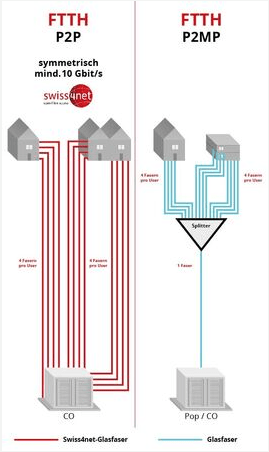
Not all fibre networks are the same. With point-to-point (P2P) FTTH fibre networks, the fibres are pulled directly into the residential or commercial unit. In contrast, other models such as FTTB, FTTS, FTTC continue to use copper or coaxial lines over the last mile and the connections are split into nodes.
A further distinction must be made between point-to-point and point-to-multipoint FTTH fibre networks. While end-users benefit from a dedicated fibre in a point-to-point (P2P) FTTH fibre network, in a point-to-multipoint (P2MP) FTTH fibre network, the fibre connection is shared by several parties. Only with a point-to-point (P2P) FTTH fibre network can it be ensured that users receive the maximum bandwidth at all times. Due to the dedicated fibre, the data and failure safety is also said to be much higher.
The pure point-to-point (P2P) model is said to be open in terms of technology for future FTTH developments and individual requirements of the providers. “Thanks to their own fibre-optic connections from the central office to the end customer, providers could select and implement their preferred technology themselves. Even the already popular XGS-PON (10 Gbps Symmetric Passive Optical Network) could be offered to end customers without restrictions via the P2P network”, according to Swiss4net.
The P2MP model has no continuous fibre from the central office to the end customers. A point-to-multipoint (P2MP) network carries only one fibre on the first section from the central office to the duct (in the street FTTS or in the building FTTB) and from this distribution point onwards the fibre is usually divided among 32 end customers by means of splitters. In addition, layer 1 access in P2MP is said to be restricted for telecom providers. A P2MP model may also be more susceptible to interference in the connections, as an entire P2MP tree (consisting of all 32 customers of a provider) is always affected, according to Swiss4net
For Example – Swiss4net offers Point-to-point (P2P) FTTH construction and has started projects in Ascona (2020) Baden (2013) Morges (2021) and Pully (2020)
Source – Swiss4net – Feb2023
“After more than 30 years of development, optical fiber technology has improved to achieve state-of-the-art commercially available links capable of up to 50 Gbps rate (per wavelength/per fiber) over more than 20 km reach”. Source – Re-Inventing Wires: The Future of Landlines and Networks – May 2018
P/s During 2020 LVsA submitted a petiton to our commune requesting the speedy negotiation and installation of FTTH as the preferred solution in upgrading our village to the internet. During 2021 Swisscom installed only Fiber to the Street (FTTS) instead of the preferred Fiber to the Home (FTTH)…

FTTH is faster, safer, more reliable, and far more cyber secure and energy efficient than wireless transmissions. The best alternative to wireless is Fiber to the Home – FTTH
