
ORSAA.org – Oceania Radiofrequency Scientific Advisory Association.
ORSAA – 17mar2026.
A new Australian study shows that over 26 million adults are likely to experience health problems from exposure to wireless radiation in three countries alone. That includes one in six Australians – over 4.5 million.
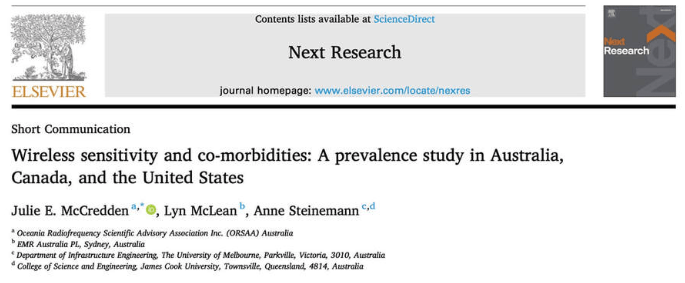
The study, by Dr Julie McCredden, Lyn McLean, and Professor Anne Steinemann, has just been published in the journal Next Research.
‘People report they feel unwell around common wireless devices and sources, such as mobile phones and WiFi systems. Doctors have diagnosed this sensitivity as a medical condition. So, we wanted to find out: How widespread is this condition?’ said Professor Steinemann.
The authors described wireless sensitivity as ‘the experience of adverse health symptoms from exposure to wireless (radiofrequency) radiation’ and say these can range from uncomfortable to disabling. ‘Common symptoms include headaches, dizziness, cardiovascular problems, tinnitus, difficulty concentrating, nervous system effects, irritability, insomnia, fatigue, burning face, nausea, and dysesthesia.’
To determine the prevalence of wireless sensitivity, Steinemann conducted an online survey using a random sample of 3,475 adults, who were statistically matched by age, gender, and location to the general populations in Australia, the USA, and Canada.
The researchers found that an average of 12.6% of all respondents reported experiencing wireless sensitivity. The highest prevalence was in Australia, where more than one in six adults were affected (17.4%), followed by the US (12.8%) and Canada (7.5%).
Wireless sensitivity is sometimes known as Electromagnetic Hypersensitivity (EHS), so Steinemann also investigated the prevalence of medically diagnosed EHS. Again, Australia had the highest prevalence (14.9%), followed by the US (10.1%) and Canada (5%).
Overall, 18.9% of Australians reported having wireless sensitivity, diagnosed EHS, or both conditions. In the US, it was 14.3%, and in Canada, 8.7%, reporting one or both conditions.
The study found that, compared with the general population, more males than females reported wireless sensitivity. Among all gender/age groups, the most affected were males aged 25 to 34, and the second most affected were males aged 35 to 44.
‘As males comprise more than half of the Australian workforce, this finding has important implications for workers and employers,’ said Dr Julie McCredden, the lead author of the paper.
The study also investigated the prevalence of several other conditions linked to environmental exposures – chemical sensitivity, asthma, autism and fragrance sensitivity – and whether these conditions overlapped with wireless sensitivity and EHS. It found a large overlap for all conditions.
Of the people who reported wireless sensitivity and/or had a diagnosis of EHS:
- 90.4% had chemical sensitivity or diagnosed Multiple Chemical Sensitivities in Australia (83.5% in US and 67.7% in Canada);
- 84.2% had asthma or asthma related conditions in Australia (67.6% in US and 67.7% in Canada);
- 74.2% had autism or autism spectrum disorders in Australia (52.7% in US and 34.4% in Canada); and
- 92.8% had fragrance sensitivity in Australia (81.3% in US and 80.2% in Canada).
The authors say that the link between wireless sensitivity, EHS and other environmental conditions suggests that similar effects might be occurring in the body. Previous research has also found common factors, such as inflammation, underlying sensitivity-related conditions.
Even though the prevalence of wireless sensitivity in this study is higher than in many previous studies in other countries, the authors believe that it could, nevertheless, underestimate the actual prevalence of wireless sensitivity in the population. That’s because, ‘People experiencing symptoms of wireless sensitivity may not recognize wireless radiation as a possible cause,’ the authors say. ‘Medical professionals may not consider or diagnose wireless sensitivity/EHS. Further, the online format of the survey may preclude participation by individuals with wireless sensitivity/EHS.’
Lyn McLean, a co-author of the study, is not surprised by the study’s finding that over 17% of Australians are sensitive to wireless radiation. ‘I have been working in this field for over 30 years and, in that time, thousands of people have told me they are sensitive to wireless radiation. Some of them have such severe sensitivities that they are no longer able to work or even spend time in public locations where there is wireless radiation. I’m glad our study was able to throw light on this important issue.’
Wireless radiation is emitted by personal and household devices such as mobile and cordless phones, baby monitors, wireless routers, computers, tablets, earpods, fitness trackers, and smart watches; by smart meters in power-boxes and on water meters; by cars and public transport; by mobile phone base stations; and is present in most public buildings, schools, and workplaces.
Access to the paper and additional resources: https://www.orsaa.org/ehs-research.html
Media enquiries: publishing(@)orsaa.org
ORSAA – Media Release
ORSAA.org – Oceania Radiofrequency Scientific Advisory Association
Source – ORSAA – New Research shows that 1 in 6 Australian Adults are sensitive to wireless radiation.
