Associazone Frequenze Evolutive (AFE) Ticino 29sep2026.
Autotranslation from Italian.
Sweden was one of the first countries to embrace the digitization of education and has always been considered a pioneer in the adoption of new technologies. That was until 2022, when, in the Program for International Student Assessment (PISA), nearly one-quarter of Swedish students failed to reach the basic level of reading comprehension! The data is irrefutable: over the past 10–15 years, students’ reading skills, attention spans, and ability to analyze information have deteriorated across all international tests. Research from the Karolinska Institutet has further confirmed that there is clear scientific evidence that digital learning, rather than improving, actually impairs learning.
Starting the following year, the government took corrective action by deciding to pursue a policy that would promote traditional learning tools (books, notebooks, and cursive writing) and prioritize time spent reading over time spent in front of screens and tablets, launching the slogan “From the Screen to the Notebook.”
In 2026, the Swedish government’s concrete response came: a total ban on cell phones in compulsory schools (ages 7–16) for the entire school day became a mandatory national law. For some Swedish high schools, the change is already a reality: upon entering the classroom, students deposit their cell phones in a special container called “Cell Phone Hotel” and retrieve them only at the end of the day. Melina S., a 17-year-old student at Malmö Borgarskolan High School, admitted: “When you have a phone, there’s always something to look at!”—confirming that the absence of limits fosters addiction!
The school’s vice principal, Patrick Sander, points out that his school’s goals are:
- To drastically limit the use of laptops to only those times when they are strictly necessary for educational purposes.
- For teachers to encourage handwriting.
Sander confirms that: “These days, we see that the trend is moving in the opposite direction; we have found that writing by hand stimulates concentration and aids memorization and learning.”
This year, Sweden has made further investments as part of a new grant program for the purchase of textbooks and teacher’s guides, based in part on research by Professor Magnus Haake, an associate professor of cognitive science at the University Lund University, which confirms that the entire cognitive system is enhanced when learning takes place using physical materials that engage the motor and sensory areas of children’s brains.
As part of this program, the Swedish government subsequently also requested the participation of the public health agency, tasking it with providing guidance to parents on how to reduce screen time within the family.
An international phenomenon
The concerning result observed in 2022 in Sweden (a country that allocated 2 billion kronor for a return to pre-digitalization conditions) does not differ significantly from the European average as reported by the OECD (Organization for Economic Cooperation and Development).
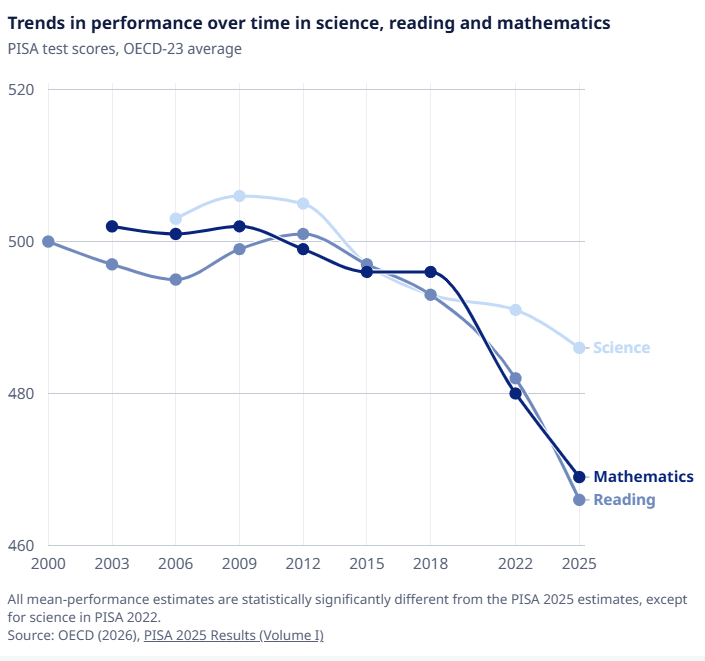
The results of the PISA 2025 study, published on September 8 of this year, also confirm this downward trend across all subjects. Switzerland ranks slightly above the OECD average, while our canton, although it manages to remain above the global average, appears to be in free fall relative to the Swiss average.
Sweden’s decision is part of a broader global re-evaluation of the use of smartphones in schools. Following the boom years, during which many countries—including Ticino—had equipped their classrooms with laptops, tablets, and interactive whiteboards, other countries have introduced a ban similar to Sweden’s: France, China, Denmark, Finland, Spain, and South Korea. Twenty-four U.S. states have also reversed course on digital technology, issuing specific guidelines for teachers to return to cursive writing, reading aloud, and silence in the classroom, because “cursive facilitates the development of hand-eye coordination, keeps children away from screens, and helps preserve the essential spaces of experience.”
The Ticino government, too, has implemented new guidelines effective March 30, 2026, which include a ban on the use of mobile devices in compulsory schools throughout the entire school grounds. Mobile devices must always be turned off and out of sight during school activities. State Councilor Marina Carobbio Guscetti, in her capacity as head of the DECS and as a physician, recognizes the important role played by schools in what she defines as “a societal problem.”
It’s clear that digital technology speeds things up, simplifies them, and provides immediate gratification; but unfortunately, information slips away easily without penetrating the mind or taking root in memory. Learning has always required time and effort. Writing by hand, knowing how to navigate a page, and underlining what is considered important activates deeper pathways in the brain than quickly scrolling through screens. We must ask ourselves what kind of adults we want in the future. An increasingly digital school system risks creating minds that are constantly connected but struggle with concentration, imagination, and critical thinking.
Sweden’s decision confronts us with the true concept of progress, which is not about filling every free space with technology, but rather the ability to preserve what makes learning human: namely, attention, depth, and time!
The current system has generated enormous profits for Big Tech, while the minds of our young people have become increasingly less capable.
Knowing doesn’t just mean knowing how to click; knowing is the ability to transform what you read, hear, and experience into an inner experience!
Source – Associazone Frequenze Evolutive (AFE) InForma Settembre 2026 (in Italian)
Note – LVsA – Autotranslation with DeepL – Added links picture and modified post heading
- Programme for International Student Assessment (PISA) – PISA is the OECD’s Programme for International Student Assessment. PISA measures 15-year-olds’ ability to use their reading, mathematics and science knowledge and skills to meet real-life challenges.
PISA 2025 – Education performance continues to decline, with huge drops in reading
“The PISA results reveal an uneven picture of educational performance, with learning outcomes largely stagnating or continuing to decline in many countries. In science, the main focus of PISA 2025, average scores fell modestly across OECD countries between 2015 and 2025, while remaining broadly stable in other countries and economies. In mathematics, average scores fell by 22 points between 2015 and 2025 across the OECD, with performance also declining among non-OECD members. Reading recorded the steepest drop, with scores falling by 28 points across OECD countries and by 16 points among other countries and economies between 2015 and 2025.”