Dr. David Carpenter on the Science
ICBE-EMF 10july2026.
What does decades of scientific research say about the health risk of EMF magnetic fields from high-voltage power lines and substations?
In this in-depth interview, Dr. David O. Carpenter, a Harvard-trained physician and one of the world’s leading experts on electromagnetic fields (EMF), explains the science on powerline EMF health risk and why the magnetic fields from power lines remain an important health and safety issue.
Dr. Carpenter has published over 500 peer-reviewed scientific publications and has edited six books. Among his numerous papers on non-ionizing electromagnetic fields, he published a major review of the research on EMF from power lines and cancer in the journal Environmental Research, which found magnetic field EMF exposure increases the risk of childhood leukemia. There is also scientific evidence for adult leukemia, brain and breast cancer. The review also compared industry-funded research to independently funded studies and found “almost all government or independent studies find either a statistically significant association between magnetic field exposure and childhood leukemia, or an elevated risk of at least OR = 1.5, while almost all industry-supported studies fail to find any significant or even suggestive association.”
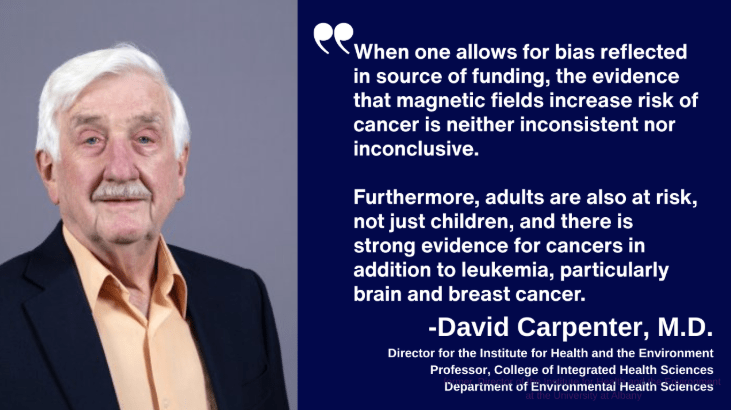
“The evidence that magnetic fields increase the risk of cancer is neither inconsistent nor inconclusive. Furthermore, adults are also at risk, not just children, and there is strong evidence for cancers in addition to leukemia, particularly brain and breast cancer.”
- David Carpenter in Environmental Research “Extremely low frequency electromagnetic fields and cancer: How source of funding affects results”
David O. Carpenter M.D. is Director of the Institute for Health and the Environment, a Collaborating Centre of the World Health Organization, at the University at Albany. He is also a Commissioner of the ICBE-EMF (International Commission on the Biological Effects of Electromagnetic Fields).
Dr. Carpenter directed the New York State Power Lines Project, one of the largest government-funded research programs investigating the health effects of electric and magnetic fields. He discusses the history of EMF research, the evidence linking long-term exposure to magnetic fields with childhood leukemia, and why he believes scientific findings have been misunderstood and minimized.
Topics Covered in this Interview
- The research linking high-voltage power lines to childhood leukemia
- How industry-funded studies differed from independently funded research
- Why U.S. research funding on ELF magnetic fields largely disappeared
- Why substations and high-voltage transmission lines should not be located where children, athletes, or residents spend long periods of time
- How buried transmission lines can substantially reduce magnetic field exposure
Dr. Carpenter also discusses why he believes policymakers should re-examine the extensive body of published EMF research and implement protections. He states that electricity is essential to modern society, but argues that infrastructure should be designed in ways that minimize unnecessary long-term exposure where people live, attend school, and spend significant amounts of time.
Watch the full interview to learn about the history of EMF research, the scientific evidence on magnetic fields from power lines, and what communities should know when evaluating new transmission line and substation projects.
Some recent scientific publications on high voltage transmission lines, magnetic fields, and cancer risk.
- A 2022 systematic review by Brabant et al. in Reviews on Environmental Health found that long-term exposure to magnetic fields above 0.4 µT (4 milligauss) was associated with increased risk of childhood leukemia, particularly acute lymphoblastic leukemia.
- A 2021 meta-analysis of 33 studies concluded a significant association between powerline ELF exposure and childhood leukemia, with possible dose-response effects.
- A study of children in Mexico City by Correa‐Correa et al. 2025 found children exposed 4 milligauss (ELF-EMF) in their homes had a significantly increased risk of central nervous system tumors. Prolonged tablet use also increased CNST risk, especially in children aged 6–10. Residential ELF-MF exposure was measured over 24 h.
- A study by Lowenthal et al. (2007), published in the Internal Medicine Journal, found that people who lived within 300 meters of high-voltage power lines during childhood had significantly elevated risks of lymphoproliferative and myeloproliferative disorders, including approximately threefold higher risk during the first 15 years of life and up to fivefold higher risk with exposure in early childhood.
- A large 18-year nationwide cohort study of over 3.5 million people published in Environment International (2026) found increased risk of dementia and Alzheimer’s mortality associated with living close to electrical grid infrastructure like powerlines and substations.
IEEE and ICNIRP limits for magnetic fields do not protect from cancer risk
Dr. Carpenter explains that IEEE and ICNIRP limits primarily address short-term, acute effects (such as nerve stimulation), not long-term EMF exposure health effects. In 2002, the WHO’s International Agency for Research on Cancer (IARC) determined that ELF-EMF magnetic fields are “possibly carcinogenic” to humans. The US does not have federal safety limits for magnetic field exposure, as the EPA was defunded decades ago. The often cited ICNIRP and IEEE exposure limits for fields at 60 Hz are 2,000–9,000 milligauss. However, the levels at which epidemiologic studies have reported associations with childhood leukemia are at 3–4 milligauss.
Source – ICBE-EMF – Power Lines, EMF, Childhood Leukemia, and Public Health: Dr. David Carpenter on the Science
- Wie gesund sind Hochspannungsleitungen?
- Gigaherz – Suchresultate – “hochspannungsleitungen”