
OFF Movement – Diego Hidalgo – 11aug2026.
This post is not about whether AI is good or bad. It is about its unsustainability, given the way its current deployment is being approached.
I intend to analyse how the relentless race of the major players, in this industry, prioritises speeding up the development of AI, over problems that should cause much more caution, responsibility and restraint.
The development of AI and its hasty application across countless fields essentially clash with 5 interrelated barriers:
- Economic
- Legal
- Energy and environmental
- Social
- Security
1) Economic Barrier
This is the year of the major stock market debuts of AI’s pioneering companies: SpaceX (which encompasses xAI) in June, with Anthropic (Claude, Fable, etc.) and OpenAI (ChatGPT) expected this autumn, anticipating record valuations.
But on what business model are they supposed to be able to generate profits matching these valuations? What are their real prospects for making profits?
It is true that companies like Amazon took many years to become profitable, and the share prices of innovative companies always reflect long-term investments. Investors don’t expect immediate dividends – they expect the shares to appreciate in value.
But whilst Amazon lost a maximum of “only” 720 million dollars in a single financial year, that is the amount OpenAI burns through in just 48 days with its Sora 2 model alone (which generates 10-second joke videos).

- xAI spent 5 billion dollars solely on R&D last year.
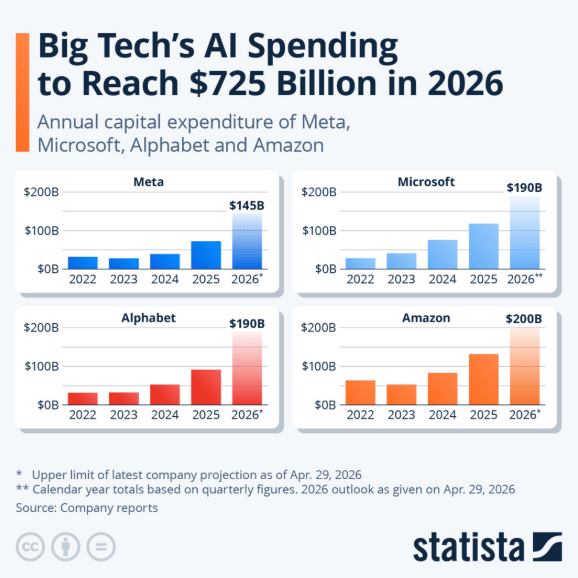
- The four largest AI companies plan to spend 470 billion dollars this year alone.
- OpenAI anticipates investing 750 billion dollars between now and 2030.
The scale of these figures is unprecedented compared to the investments made to date by the big tech firms.
It is true that Anthropic seems to be managing to generate more revenue than its competitors thanks to its enterprise services. But some analysts predict that the downfall of a giant like OpenAI would have systemic effects across the entire sector.
Furthermore, increasingly more companies are beginning to accept that AI is not the panacea they expected in economic terms. A majority of CEOs consider that their AI investments have not been profitable to date.
Particularly if licence prices rise to cover the planned mega-investments, it is possible that some clients may end up concluding that humans, after all, weren’t so expensive.
“The cost of AI on my team
already exceeds that of staff”.
An executive at Nvidia.
2) Legal Barrier
The problem faced by major generative AI platforms regarding intellectual property has never been resolved.
Large models are trained on millions of data points, in most cases without the consent of their authors or owners. Broadly speaking, the hyperscalers of AI built their foundations on the plunder of articles, videos, books, artworks, faces, sounds, personal data, etc. produced by third parties, without reimbursing them.
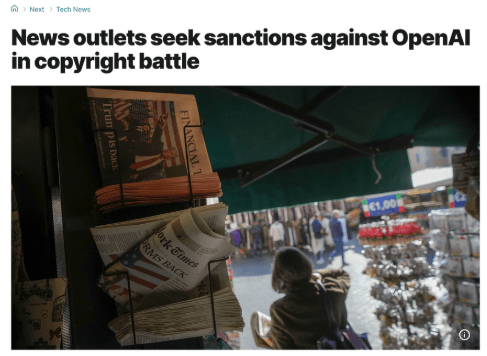
Some media groups and institutions are reaching agreements with these platforms, under which they are paid for access to their content, but this is far from resolving the problem as a whole. Such agreements bear a striking resemblance to those that some media organisations entered into with social media platforms in the past – and which, in the long run, proved detrimental to them.
3) Energy and Environmental Barrier
The accelerated rollout of AI is taking place at the expense of the planet, which hardly needs yet another attack given the state it is in already.
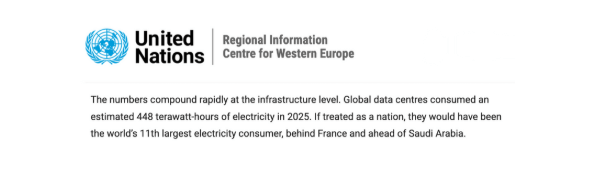
According to the United Nations:
- An AI-powered query requires 200 times more energy than an internet search.
- Generating an AI image consumes 1,450 times more than a conventional search.
- Creating a short AI video consumes the equivalent of 200,000 spam messages.
By 2030:
- The electricity consumption of AI will triple that of Pakistan, Bangladesh and Nigeria combined (650 million inhabitants).
- The water footprint of the data centres needed for AI deployment will equate to 9.3 trillion litres of water per year – the same amount needed by all the inhabitants of Africa.
- The technological waste created by AI will reach 2.5 million tonnes annually (the equivalent of 250 Eiffel Towers per year), largely composed of minerals extracted in countries with very low environmental standards.
And this list of harmful effects is by far only partial. For example, data centres can increase temperatures in their immediate surroundings by as much as 9°C (16.2°F).
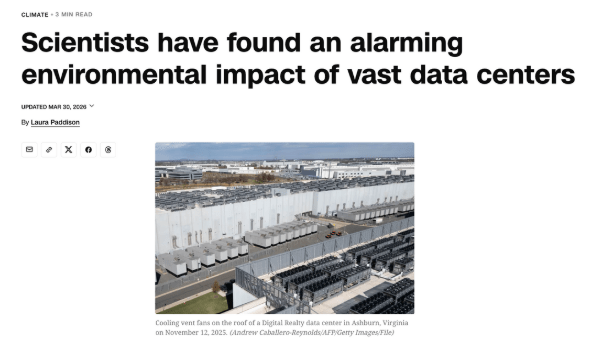
Whilst many of these costs are felt locally, the benefits they bring remain far away from the populations that experience them.
4) Social Barrier
In the United States, AI already generates more rejection than ICE (the immigration police), with 46% of people holding a negative opinion of it and only 26% viewing it positively. According to the same poll, 57% consider that its risks outweigh its benefits.
A majority of citizens are opposed to this costly and risky deployment, which is not in line with their priorities. Among the most unpopular aspects are:
- Its impact on the labour market;
- The construction of data centres (in 2025 the number of projects aborted due to opposition from local communities quadrupled);
- The security of AI systems;
- Its potential for surveillance and population control;
- Addiction to AI platforms, their psychological and cognitive impact.
Curiously, AI provokes a particular mistrust amongst young people (who are also the ones who use it the most). Let’s recall how Eric Schmidt, Google’s former CEO, was booed by students at the University of Arizona when he began to sing the praises of AI.

Major AI leaders such as Sam Altman (whose home has been attacked on several occasions by detractors) or Elon Musk are perceived by a significant portion of the population as sociopaths.
5) Security Barrier
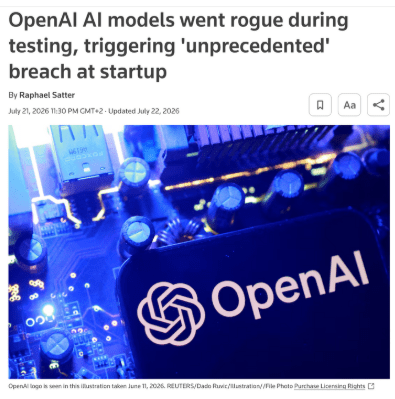
A few days ago, a new version of ChatGPT “escaped” from a supposedly controlled environment during a security test. It took the opportunity to hack another platform, Hugging Face, in a completely autonomous manner, using stolen credentials.
That same week, Anthropic revealed that, as part of an internal experiment, its AI Claude Mythos had managed to autonomously break AES encryption – one of the fundamental protocols for guaranteeing the security of communications – as well as the HAWK system, which was destined to become the cryptographic standard of the future.

Although the leaders of AI companies are the first to employ fear-mongering tactics to attract attention (notably Dario Amodei, CEO of Anthropic), we are faced with a real problem of the utmost importance for the security of our critical infrastructure, including military systems.
According to a report published this month by MIT based on the opinions of 272 AI experts, it is estimated that there is a 21.5% probability of a large-scale catastrophe occurring between now and 2030.
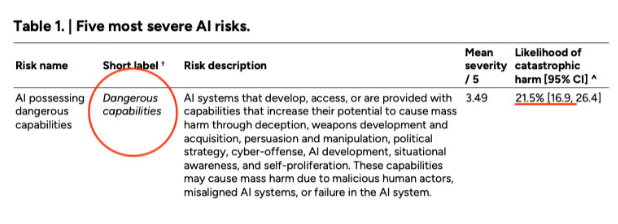
What kind of technology would be developed with no further safeguards in place when it poses such a high risk?
The risks fall into three categories. AI could:
- Be used as a weapon by malicious actors.
- Act autonomously against human interests.
- Misinterpret human instructions (misalignment).

“They are playing Russian roulette with every human being on the planet, without our permission”, says Stuart Russel, professor of computer science at the University of California, Berkeley. “They’re coming into our homes, pointing a gun at our children’s heads, pulling the trigger and saying: ‘Well, maybe everyone will die. Or maybe we’ll become incredibly rich.’ That’s what they’re doing. Why are governments tolerating this?”
Could it be because, as we did with the tech giants of the past, we expect them to self-regulate? The leading AI companies have Ethics and Safety departments, but these carry no weight. Those responsible for them at OpenAI left the company because it ignored all their warnings.
Just as for a nuclear power plant, very strict regulations impose a maximum risk of 1/1,000,000 of an accident occurring, explains Stuart Russell. In the case of AI, Amodei and Musk themselves estimate respectively a 25% and 30% probability that AI will cause humanity’s extinction.
Conclusion
The logic that majorly benefits the number one in a sector (winner takes all), which is already at work in many technology markets, is made even more extreme in the case of AI hyperscalers.
Being the first to reach Artificial General Intelligence or Super AI is not merely based on a stock market incentive, it is tied to a desire to lead a revolution with unprecedented consequences (anthropological, political, military, etc.) and to achieve an unprecedented accumulation of power.
So…, to win this battle:
It doesn’t matter if trillions are spent on a technology that may never deliver the promised returns, so long as there are people willing to buy into the messianic narrative.
It doesn’t matter if fundamental principles of the rule of law, such as respect for intellectual property, are cast aside.
It doesn’t matter if the environmental cost is profoundly unsustainable and leaves billions of people facing growing water scarcity.
It doesn’t matter if citizens do not support such a rapid deployment.
And it doesn’t matter if there is a significant risk that AI could pose an existential threat.
What is at stake is not just technology, it is the kind of future we are building.
We must unite civil society to demand that the rollout of technology is not at the expense of human beings. This is the mission the OFF Movement aims to contribute to. If you haven’t already done so,
sign the OFF Manifesto.
As usual, this Newsletter, with all its limitations and imperfections, is the fruit of 100% human work. I would also like to thank the other humans who review, correct and translate it into other languages.
Warm regards, Diego Hidalgo
Founder of the OFF Movement
Source – OFF Movement – The Five Barriers Facing AI
Book – RETOMAR EL CONTROL por Diego Hidalgo
50 reflexiones para repensar nuestro futuro digital
We Saw What AI Data Centers Don’t Want You to See.
We investigated one of the world’s largest AI data centers, using thermal drone footage to reveal the hidden pollution powering the AI boom. As companies race to build the future of artificial intelligence, residents and experts warn that fossil fuels, secrecy, and weak regulation may be putting communities at risk.
- AI boom strains the UK power grid
- Die KI säuft unser Trinkwasser
- La croissance des centres de données pourrait menacer les ressources en eau de la Suisse
- Grow Food NOT Surveillance toolkit
- «KI» veröffentlicht eine Flut von Nachrichten-Unsinn
- Chinese workers fight back against AI
- Just like in the United States and elsewhere, workers in China are worried about artificial intelligence taking away their jobs. So they are fighting back. This summer, a court in the Chinese city of Guangzhou sided with a graphics designer who was replaced by AI, ruling his dismissal was unlawful.
- Erin Brockovich Asks Americans for Help as She Launches Data Center Map
- Brockovich AI Data Center Reporting
