
ICBE-EMF – 19nov2026.
ICBE-EMF calls for an independent scientific assessment, stronger exposure limits, and risk-reduction protective measures for children and other vulnerable populations regarding non-ionizing EMF exposure. Sources include cell towers, cell phones, Wi-Fi, Smart meters, power lines, and electric substations.
The International Commission on the Biological Effects of Electromagnetic Fields (ICBE-EMF) has submitted scientific comments to two US federal agencies- the Federal Communications Commission (FCC) and the Department of Health and Human Services (HHS)- calling for an independent assessment of EMF health effects and stronger public health protections.
The submissions bring complementary requests to the two agencies, including the request to strengthen the FCC’s exposure limits for wireless radiofrequency (RF) radiation and commission an independent HHS assessment covering non-ionizing electromagnetic fields from wireless radiation to power-frequency fields, and static electromagnetic fields.
The Urgent need for an Independent Scientific Review
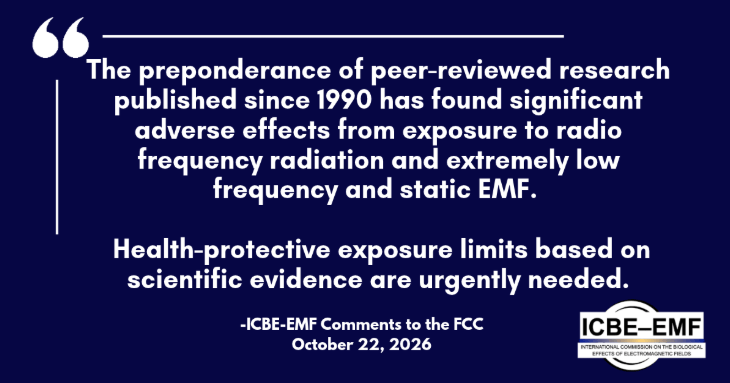
ICBE-EMF, an international consortium of scientists, physicians, engineers, and public health experts, is calling for an “independent, transparent, multidisciplinary assessment” of the health and environmental effects of non-ionizing EMF. The review should examine chronic and low-level exposures, biological effects beyond heating, and risks to children and other vulnerable populations. They are calling for a public workshop within 90 days and for measures to lower EMF exposure and reduce associated risks to public health and the environment.
The ICBE-EMF submissions highlighted the substantial scientific research on non-ionizing electromagnetic field radiation reporting cancer, reproductive and developmental outcomes, neurological effects, cellular stress, and environmental impacts. The ICBE-EMF submitted its published studies challenging the assumptions underlying current FCC and ICNIRP exposure limits, the interpretation of recent WHO-commissioned reviews as assurances of safety and its analysis of the experimental animal studies, which estimated that current whole-body RF exposure limits for the public are 15 to 900 times higher than the levels they calculated for a one-in-100,000 excess cancer risk, depending on daily exposure duration.
Measures to Protect Children and Vulnerable Populations
Both submissions emphasize children’s health and ICBE-EMF’s position that – “The right to a safe and healthy environment is fundamental to children’s human rights.”
Recommendations for Schools
- Replace all Wi-Fi networks with hardwired, shielded Ethernet internet connections.
- Purchase laptops and tablets with Ethernet capability, and with easy steps to disable wireless antennas so that computers connect to the internet with Ethernet only.
- Require that all cell phones be powered off for the entire school day and stored in a Faraday box or other shielded storage to reduce unnecessary RF exposure and minimize classroom distractions.
- Require that all devices and technology equipment used in schools have wireless transmitters (intentional radiators) disabled, ensuring that no wireless radiation sources operate within school buildings.
- Provide wired telephones for personnel in all classrooms.
- Educate students, staff, and families on the risks of wireless and EMF exposure and how to reduce exposure.
- Minimize ELF exposures by ensuring adequate grounding, use of shielded cabling, twisted wiring, and devices with low ELF emissions.
- Ensure students are at a distance from electrical equipment and charging stations.
- Prohibit cell towers/base stations and other wireless emitting antennas on or near school property as is already the policy in some countries and U.S. school districts.165
- Prohibit high-voltage power lines and electrical substations on or near school property.
- School boards should maintain a team that can routinely conduct transparent, independent real-time EMF measurements (including body-worn dosimeters) in classrooms, playgrounds, and sports fields to ensure the lowest possible levels are maintained.
- Continuously mitigate as required to ensure the above principles are adhered to.
The expert commission called for EMF exposure reduction in schools and greater attention to pregnant women, workers, and people with electromagnetic hypersensitivity (EHS). The commission included a position statement on electromagnetic hypersensitivity as a humanitarian crisis and called for hypersensitivity to be formally recognized and for accommodations that improve access to housing, healthcare, education, employment, and public spaces.
What ICBE-EMF is asking U.S. federal agencies to do:
- Place an immediate moratorium on the further development of 5G and 6G wireless technology until safety is demonstrated.
- Commission an Independent Assessment: Convene a multidisciplinary panel with transparent selection criteria, conflict-of-interest disclosures, published methods, and meaningful representation from biological, medical, epidemiological, engineering, and environmental sciences.
- Consider ICBE-EMF’s threshold dose findings: Consider incorporating the cancer and reproductive toxicological threshold dose findings reported by ICBE-EMF into an independent government-sponsored review when revising FCC RF exposure limits.
- Formally recognize Electromagnetic Hypersensitivity as an EMF-induced external cause of injury by public health agencies worldwide and the greater recognition of the needs of those who are EHS-disabled, so they have access to safer homes, healthcare, education, employment, opportunities, and equity of access in all public domains
- Convene a Public Workshop Within 90 Days: Invite federal agencies, independent researchers, clinicians, affected communities, and stakeholders; publish the agenda, evidence submissions, and proceedings.
- Coordinate Federal Agency Responsibilities:
- NIH/NIEHS: Identify research priorities on mechanisms, chronic exposure, and health outcomes.
- FDA/CDRH: Review relevant device-safety evidence.
- CDC/ATSDR: Assess communication strategies and susceptible-population needs.
- CDC/NIOSH: Evaluate occupational exposure and workplace health concerns.
- Review Exposure Guidance and Research Needs: Use the assessment to determine whether updates to federal guidance, exposure characterization, clinical research, surveillance, or targeted research funding are warranted (including consideration of low-intensity, non-thermal endpoints).
- Publish Response and Implementation Timetable: Identify a lead HHS office, responsible agencies, milestones, and opportunities for public comment.
ICBE-EMF Filing to the FCC — ICBE-EMF Submission to HHS
ICBE-EMF’s scientific publications, position statements and briefs submitted alongside the comments include:
- Conflicting views in experimental carcinogenesis: a commentary on design and methodological deficiencies in the follow-up validation studies on radiofrequency radiation
- Exposure limits to radiofrequency EMF do not account for cancer risk or reproductive toxicity assessed from data
- The WHO-commissioned systematic reviews on health effects of radiofrequency radiation provide no assurance of safety
- The Systematic Review on RF-EMF Exposure and Cancer by Karipidis et al. (2024) has Serious Flaws that Undermine the Validity of the Study’s Conclusions
- Cell Phone Radiation Exposure Limits and Engineering Solutions.
- Scientific evidence invalidates health assumptions underlying the FCC and ICNIRP exposure limit determinations for radiofrequency radiation: implications for 5G
- Position Statement on Children, EMF and Wireless
- Position Statement on Electrical Hypersensitivity
- Briefing for Policymakers on FCC Limits and Wireless.
Read All of ICBE-EMF Official Letters and Submissions
Source – ICBE-EMF Calls for U.S. Federal Action on Electromagnetic Fields and Health
